

Overview
Chris Froome officially won his third Tour de France title on July 24, 2016, after safely completing the final processional stage into Paris. The iconic headline “Chris Froome All-But Secures Third Le Tour Title” refers to the conclusion of Stage 20 on July 23, 2016. During that brutal alpine stage to Morzine, Froome successfully protected his huge general classification advantage despite dangerous rain-soaked descents and relentless pressure from rivals.
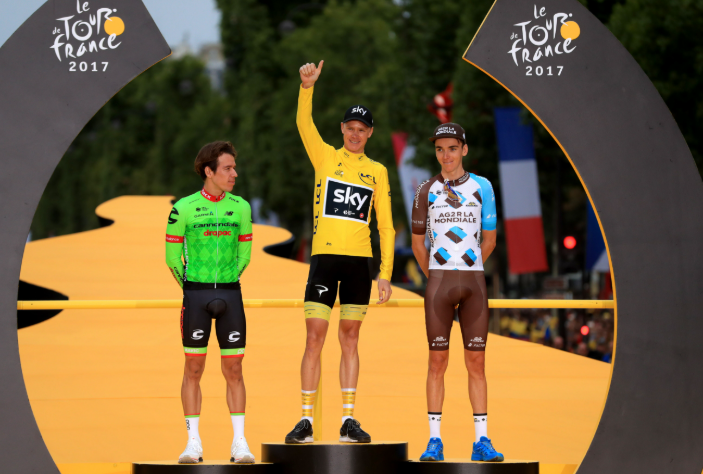
By the end of the stage, the British rider carried a commanding 4-minute and 5-second lead into the ceremonial finish on the Champs-Élysées. Froome eventually stood on the podium ahead of Romain Bardet and Nairo Quintana, completing one of the most memorable Tour de France victories of the modern era.
The 2016 Tour de France final top five included:
- Chris Froome – Team Sky
- Romain Bardet – AG2R La Mondiale
- Nairo Quintana – Movistar Team
- Adam Yates – Orica–BikeExchange
- Richie Porte – BMC Racing Team
The race became legendary because of Froome’s aggressive tactics, downhill attacks, time trial dominance, and the unforgettable Mont Ventoux running incident that shocked the cycling world.
A Tour de France Victory Built on Intelligence and Courage
In my experience watching Grand Tours over the years, very few victories combined strategy, resilience, and unpredictability quite like Froome’s 2016 Tour de France campaign. This was not simply a rider defending a yellow jersey. It was a complete display of modern cycling intelligence.
By Stage 20, the race was effectively over. Froome had survived the Alps, conquered the time trials, and neutralized every major threat. All he needed to do was safely reach Paris.
Yet the phrase “all-but secures” perfectly captured the tension of the moment. Cycling fans know that nothing is guaranteed in the mountains, especially during wet descents and chaotic alpine conditions.
The Morzine stage tested every rider physically and mentally. Rain poured down dangerous roads while rivals searched desperately for opportunities to attack. But Froome stayed composed throughout the chaos.
That calmness became one of the defining qualities of his championship run.
Fans who followed Chris Froome’s legendary rise in cycling often compare the global reach of the Tour de France with other internationally followed competitions, making it interesting to explore the Most Popular Sport in the World and how cycling continues to earn a massive worldwide audience.
The Key Moments That Defined Froome’s Third Tour de France Title
The Mont Ventoux Incident That Shocked the Cycling World
One of the most unforgettable moments came during Stage 12 on the legendary Mont Ventoux climb.
A television motorbike suddenly stopped amid packed crowds, causing a collision involving Froome and several riders. His bicycle was damaged beyond use.
What happened next instantly became cycling history.
Instead of waiting helplessly, Froome began running up the mountain in cycling shoes while carrying no bike. It looked surreal. Fans watching around the world could hardly believe what they were seeing.
Eventually, he received a replacement bicycle and minimized his time losses.
In my experience, moments like this often define champions more than victories themselves. Froome’s reaction showed determination under pressure rather than panic.
That image of him sprinting uphill became symbolic of the entire 2016 Tour.
Tactical Versatility Changed the Race
Another reason Froome dominated the Tour was his willingness to attack in unexpected situations.
Traditionally, Tour contenders wait for mountain summit finishes to make decisive moves. Froome changed that approach entirely.
During Stage 8 into Bagnères-de-Luchon, he launched an aggressive downhill attack that caught rivals completely off guard.
Then came Stage 11, where brutal crosswinds split the peloton apart. Froome joined forces with Peter Sagan in a high-speed breakaway that gained valuable time on competitors.
These tactical risks separated him from pure climbers.
He was no longer just surviving mountains. He was controlling every type of terrain.
Time Trial Dominance Secured the Yellow Jersey
If the mountain stages created excitement, the individual time trials created separation.
Froome’s performances during Stages 13 and 18 were devastating for his rivals.
He produced massive time gaps against elite climbers and all-around contenders alike. By the final week, the race looked firmly under his control.
What impressed me most while revisiting the 2016 Tour was how complete Froome’s riding style had become. He could climb, descend aggressively, handle crosswinds, and dominate solo time trials.
That versatility is extremely rare in Grand Tour cycling.
It also explains why his lead eventually stretched beyond four minutes.
Team Sky’s Ruthless Control
No discussion of the 2016 Tour would be complete without mentioning Team Sky.
Their tactical discipline was extraordinary.
Throughout the race, teammates protected Froome from wind exposure, controlled dangerous breakaways, and maintained punishing pace-setting in the mountains.
The squad’s organization reminded many cycling fans of the dominant era of Miguel Induráin during the 1990s.
Interestingly, Froome became the first rider since Induráin in 1995 to successfully defend a Tour de France title.
That statistic alone highlights how difficult back-to-back victories truly are.
The Rivals Who Tried to Stop Froome
Romain Bardet’s Aggressive Climbing
Romain Bardet delivered an excellent Tour and thrilled French fans with aggressive mountain attacks.
His descending skills and fearless riding nearly created opportunities during alpine stages.
Although he finished second overall, Bardet proved himself capable of challenging cycling’s biggest names.
Nairo Quintana’s Mountain Threat
Many fans expected Nairo Quintana to seriously threaten Froome in the mountains.
Quintana remained dangerous throughout the race, especially on steep climbs, but he struggled to gain enough time before the decisive time trials.
That weakness ultimately cost him any realistic chance of victory.
Adam Yates and Richie Porte Impressed
Young British rider Adam Yates emerged as one of the breakout stars of the Tour.
Meanwhile, Richie Porte showed strong consistency despite losing time earlier in the race.
The overall competition remained surprisingly deep, which made Froome’s final margin even more impressive.
Why the 2016 Tour de France Still Matters Today
In my experience following cycling history, the 2016 edition stands out because it represented a transition in modern racing tactics.
Froome’s victory demonstrated that modern champions could no longer rely solely on climbing ability.
Riders now needed:
- Aerodynamic efficiency
- Descending confidence
- Tactical intelligence
- Team coordination
- Time-trial excellence
- Mental resilience
Today’s stars like Tadej Pogačar and other modern contenders continue using many of the aggressive strategies Froome popularized during that Tour.
The race also highlighted how unpredictable cycling can be. Mechanical failures, weather, crashes, and split-second tactical decisions can completely reshape a three-week competition.
That uncertainty is exactly why the Tour de France remains one of the world’s most captivating sporting events.
Lessons Cycling Fans Can Learn From Froome’s 2016 Triumph
Even outside professional sports, there are valuable takeaways from Froome’s performance.
Adaptability Matters
Froome succeeded because he adapted to every situation rather than relying on one strength.
Whether facing mountain attacks, crosswinds, or crashes, he stayed flexible.
Consistency Wins Long Competitions
Grand Tours are rarely won in a single spectacular moment.
They are usually won through daily consistency, smart recovery, and minimizing mistakes.
Froome mastered all three.
Mental Strength Is Critical
The Mont Ventoux incident could have destroyed his race mentally.
Instead, it became one of his most iconic moments.
That resilience separated him from many rivals.
Chris Froome’s Legacy After the 2016 Tour
By securing his third Tour de France title, Chris Froome cemented his place among cycling’s modern greats.
He would later go on to win another Tour in 2017, strengthening his reputation as one of the defining riders of his generation.
For many fans, however, the 2016 Tour remains his masterpiece because it combined drama, tactical brilliance, adversity, and unforgettable imagery.
Very few champions have ever looked so vulnerable and so dominant at the same time.
Conclusion
“Chris Froome All-But Secures Third Le Tour Title” was more than just a headline. It captured the climax of one of cycling’s most dramatic modern Tours.
From rain-soaked mountain descents to time-trial domination and the unforgettable Mont Ventoux run, Froome delivered a performance that showcased every aspect of elite cycling.
In my experience, the greatest Tour de France victories are not only about physical power. They are about intelligence, composure, adaptability, and courage under pressure.
Froome’s 2016 triumph delivered all of that and it remains one of the defining moments in Tour de France history.